
Zara Bauer · 21 October 2026
Patterns in Migratory Bird Behavior Hint at Broader Ecological Shifts Along Elevated Routes
Researchers tracking avian movements across mountain corridors have documented consistent alterations in timing, altitude selection, and stopover duration, and these adjustments align with measurable changes in temperature gradients plus vegetation cycles along traditional elevated flyways. Data collected from multiple monitoring stations show that several species now initiate northward passages earlier in spring while extending their presence at higher elevations during fall returns, and such patterns emerge across both North American and European ranges where monitoring programs operate continuously.
Timing Shifts in High-Altitude Passages
Tracking records from the past decade indicate that species such as the alpine swift and certain warbler populations reach peak elevation crossings up to two weeks ahead of historical averages, and this advancement correlates directly with earlier snowmelt dates recorded by meteorological networks. In October 2026, automated radar systems in the Alps captured elevated densities of southward-bound flocks at altitudes exceeding 3000 meters, whereas similar scans from 2015 showed peak activity concentrated below 2500 meters during the same calendar window, and analysts attribute the difference to warmer air masses persisting longer into autumn months.
Observers note that these temporal adjustments affect not only departure and arrival but also the duration spent at staging sites situated along ridgelines, and shorter stopovers reduce opportunities for refueling before birds tackle the next segment of their journey. Banding studies coordinated through international networks reveal corresponding declines in body condition indices among individuals sampled at these higher sites, while lower-elevation refuges still support birds that maintain traditional schedules.
Route Modifications and Habitat Utilization
Telemetry devices attached to individual birds demonstrate that some populations now favor slightly offset corridors that skirt warmer south-facing slopes, and this behavioral flexibility appears in response to altered wind patterns plus insect availability at elevation. One multi-year project covering the Rocky Mountain flyway documented a measurable westward drift in golden eagle migration paths, with birds exploiting thermal updrafts that have intensified under changing atmospheric conditions, and the shift has concentrated activity over previously underused passes.
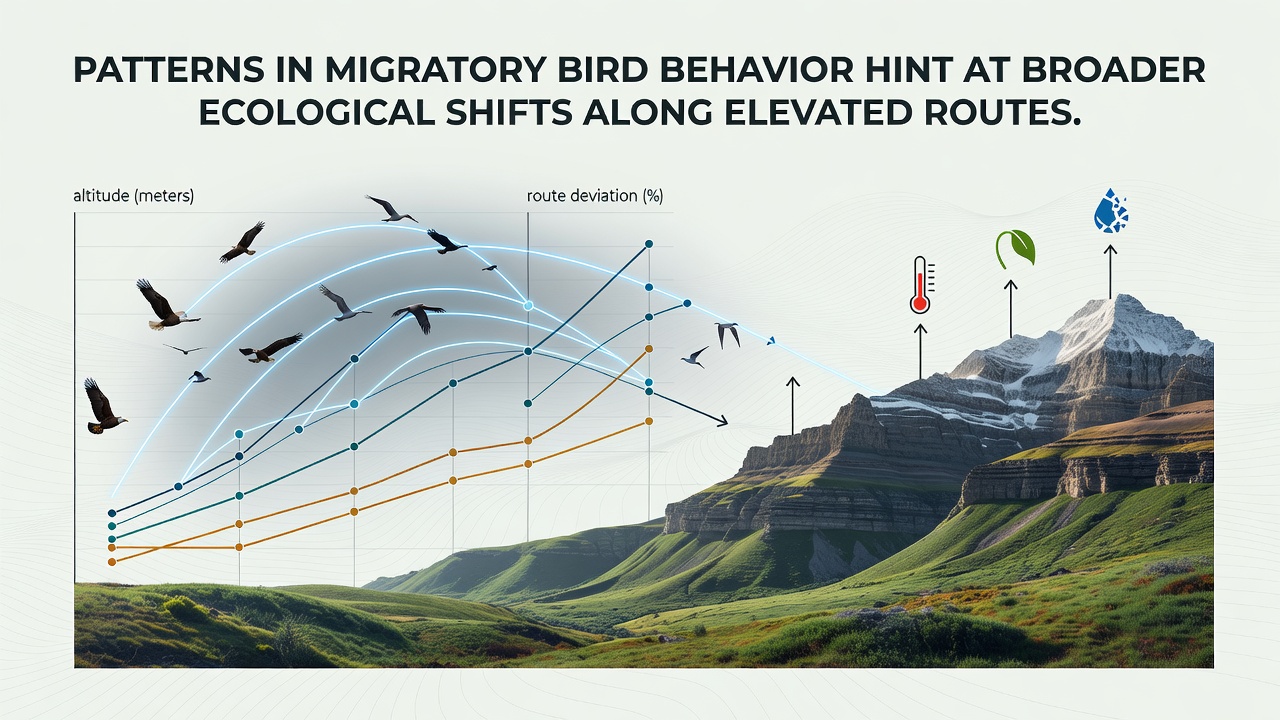
Vegetation surveys conducted alongside bird counts show that plant communities at these new waypoints have advanced their phenological stages, and the resulting mismatch between bloom periods and bird arrival windows influences the availability of nectar and seed resources. European Environment Agency reports on alpine ecosystems detail parallel observations across multiple member states, where shifts in passerine distribution coincide with documented upslope movement of deciduous shrubs into former conifer zones.
Ecological Ripple Effects Across Elevation Gradients
Changes in migratory behavior carry consequences for predator-prey dynamics and seed dispersal networks that operate along the same routes, and resident species dependent on predictable bird arrivals experience altered interaction frequencies. For instance, certain high-elevation bat populations now encounter different insect prey loads because migratory birds consume a portion of the aerial biomass during passage, and researchers have quantified these trophic adjustments through stable isotope analysis of guano samples collected from roost sites.
Soil nutrient cycling at staging areas also reflects the modified deposition patterns from bird droppings, and long-term plots maintained by university field stations record measurable differences in nitrogen levels that track bird density variations over successive seasons. Such findings emerge consistently whether studies focus on the Pyrenees, the Appalachians, or the Southern Alps, suggesting a coherent response across comparable topographic settings.
Data Integration from Global Monitoring Efforts
Collaborative databases that aggregate radar, acoustic, and GPS information allow analysts to detect continental-scale trends, and Cornell Lab of Ornithology tools facilitate cross-regional comparisons that isolate elevation-specific signals from broader latitude effects. These integrated datasets confirm that the proportion of individuals selecting higher routes has increased steadily since systematic recording began, while overall population sizes for many species remain stable or decline at rates unrelated to route choice.
Climate models calibrated against observed bird movements project continued upslope pressure under current emission trajectories, and field teams continue to expand sensor arrays to capture finer-resolution data at remote passes where human access remains limited. The resulting information streams support refined predictions for both avian conservation planning and broader assessments of ecosystem resilience at elevation.
Conclusion
Collective evidence from telemetry, radar, and field sampling establishes that migratory adjustments along elevated routes reflect measurable environmental changes rather than random variation, and these behavioral signals provide early indicators for monitoring wider ecological dynamics in mountain systems worldwide. Continued observation through 2027 and beyond will clarify whether current patterns stabilize or accelerate under ongoing climatic influences.